
Hourly ·
Shannon's perimeter had been breached three times. The fourth man brought gallium.
Prosecutors say Daithi O'Corrain spent five hours alone inside an Air National Guard C-130 parked on a Shannon taxiway, cutting hydraulic lines and shattering every cockpit gauge. The $60 million aircraft will never fly again. It was the fourth breach of the same perimeter in eighteen months.
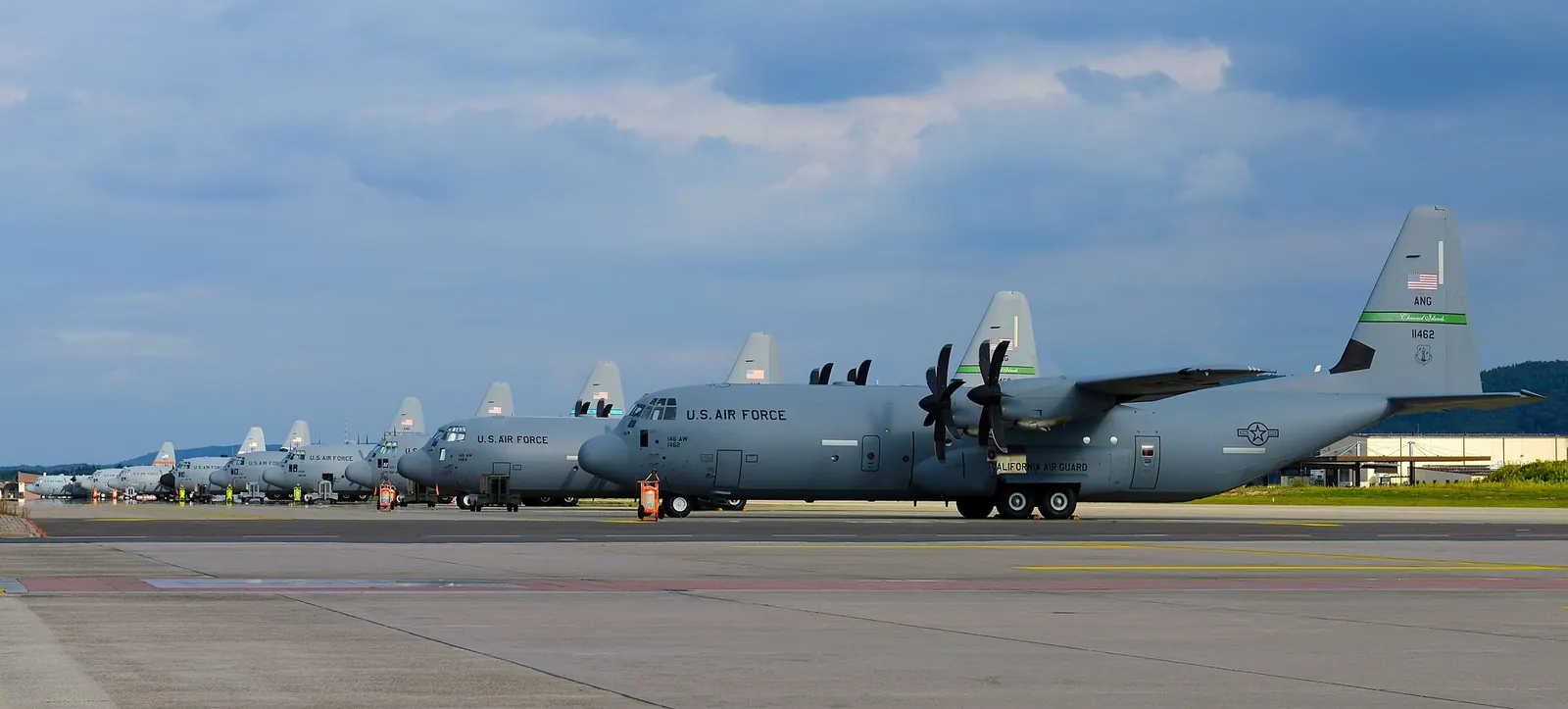
At 4:39 a.m. on April 11, a man got through the perimeter at Shannon Airport in County Clare, walked to a United States Air National Guard C-130H Hercules parked on a taxiway, broke the lock on the rear crew door and climbed inside.
He was in there for five hours. No one saw him.
The indictment unsealed Tuesday in Manhattan describes what Daithi O'Corrain, 48, allegedly did with that time. He hung the crew's hammocks over the windows, but left the cockpit windshield uncovered. He barricaded the doors with straps, brackets and screws, and packed ball bearings mixed with epoxy into the door tracks so they could not be opened or closed. Then he went to work on the aircraft: cutting wire bundles and hydraulic lines, crimping a liquid oxygen line, puncturing air ducts and smashing every gauge in the cockpit.
He had also brought multiple capsules of gallium, federal prosecutors say — a metal that melts at around 30 degrees Celsius, warm enough to liquefy in the hand, and then seeps into aluminium and turns it brittle. A C-130 is made largely of aluminium. He poured ball bearings into the fuel tanks. When the crew returned at about 9:40 a.m. and spotted him through the windshield he had deliberately left clear, he escaped through a hatch in the roof and hit the fuselage with an axe on his way out.
The aircraft is worth about $60 million. It will not fly again. The government says the damage left it inoperable and that it had to be destroyed. The C-130 had been en route to a military assignment in another country when it stopped in Ireland.
"This was not an act of spontaneous vandalism," James C. Barnacle Jr., the assistant director in charge of the FBI's New York field office, said in a statement. The defendant, he said, "spent months researching the aircraft, acquiring tools and materials, and preparing to maximize the destruction he could inflict." The attack, the FBI said, jeopardized critical military operations.
O'Corrain, who is also known as David Curran, is charged with one count of destruction of US government property, which carries a maximum of 10 years. He is not in American custody and no arraignment has been scheduled. Irish police arrested him at the airport that morning; Ireland charged him with criminal damage and trespassing, and he has reportedly been released on bail.
One act, two legal systems, and an asymmetry worth sitting with. The country where it happened treats the damage as a property crime. The country that owned the property treats it as an attack on national security.
Prosecutors say the preparation ran for months. He researched how the C-130 is built. He looked for weak points in Shannon's security perimeter. He subscribed to a flight-tracking app that follows military aircraft. He tried to contact someone who had been involved in an earlier breach at the same airport. He ordered the gallium online.
That last sequence matters because of what came before it. Since May 2025, the perimeter at Shannon had been breached three times. In May 2025, three people drove a van through the fence and were arrested. Two weeks later, three people got onto the runway and spray-painted a US military aircraft. In November 2025, three more drove a van into a restricted area where an American military plane was parked and were detained by security.
Eighteen months of people treating the fence as a stage. Charges were filed, bail was set, and the perimeter stayed what it was. The assumption underneath all of it was reasonable in Ireland: that the people crossing the fence wanted a photograph, a slogan, a court date, a story to tell. Opposition to US military transit through Shannon is a mass political position there, not a fringe conspiracy. The intruders were the argument, not the weapon.
The fourth one inverted that. He was not there to be seen. He covered the windows. He brought a chemical that eats through aircraft skin, and enough homework to know which line to crimp and which one not to cut. Prosecutors say that if he had cut the liquid oxygen line instead of crimping it, there was a high chance of a massive explosion inside the plane.
Shannon is the hinge of this story because it is two things at once. It is a commercial airport with a passenger terminal, in a country that is militarily neutral. It is also a hub for American troops and military equipment crossing the Atlantic. President Trump's Air Force One used it during his visit to Ireland in September. Ireland reconciles this with neutrality the way small countries usually do — by category. The flights are civilian aircraft making technical stops, not a foreign base, so the security around them is a civilian airport's security: a fence, a police response, a charge of criminal damage.
That is the real finding. A $60 million military aircraft, parked overnight on a taxiway, was protected to the standard of a regional airport's perimeter, because admitting anything else would mean admitting what Shannon is. The fence and the political fiction are the same object. As long as the flight is classified as civilian transit, a fence is all the protection the law requires.
Which leaves Ireland with a choice it has been deferring for decades. If Shannon is part of a war's logistics chain — and American aircraft transiting toward a conflict is not a metaphor — then it needs a military perimeter and the political argument that comes with one. If it is a civilian airport, then the most valuable things on its apron should not be other countries' warplanes, left unattended overnight.
The indictment does not allege a motive, and his supporters have supplied one. A crowdfunding page organized on his behalf describes the attack as resistance to the US war with Iran and to American support for Israel's war in Gaza, both flashpoints in Irish politics. He has been described by supporters as an independent peace activist. The US attorney's message was narrower. "These charges send a clear and powerful message that attacks on U.S. military assets — and thus our national security — will not be tolerated," Jamie McDonald said.
Both readings can be true at once. What is not in dispute is the arithmetic. Four breaches, eighteen months, one perimeter, one aircraft that will never fly again. A fence that stops three people with a van and a can of paint, and fails on a fourth who arrives with a plan, is not really a security system. It is a filter. And a filter only catches what it was built to see.
The local charges against O'Corrain are still working through Irish courts, where the alleged damage is measured in property. In New York, it is measured in national security, and the maximum is a decade. The plane, either way, is already gone — cut apart by hand, in the dark, over five hours, at an airport that calls itself civilian.
斯坦恩圍牆已經被三個人穿越。第四個男人帶來了砷。
誘導官說,達提·奧康內爾獨自花了五小時進入坎寧漢機場斯坦恩跑道上停著的一架國土安全部C-130軍用運輸機,在 Hydraulic 管線進行切割並破壞了所有儀錶盤。這架價值6000萬美元的飛機永遠不能再飛。這是十八個月內同一圍牆區域第四次被穿越。
斯坦恩圍牆已經被三個人穿越。第四個男人帶來了砷。誘導官說,達提·奧康內爾獨自花了五小時進入坎寧漢機場斯坦恩跑道上停著的一架國土安全部C-130軍用運輸機,在 Hydraulic 管線進行切割並破壞了所有儀錶盤。這架價值6000萬美元的飛機永遠不能再飛。這是十八個月內同一圍牆區域第四次被穿越。 图片來源:
More Hourlies Stories
Content on Anagnorisis is summarized, paraphrased, and editorialized from publicly available sources for length and clarity. Original sources are linked where available. All trademarks belong to their respective owners.