
Hourly ·
The FAA is replacing its 1980s copper wire. The replacement took down the country.
A contractor was converting copper lines to fiber at one remote FAA site when an error flooded the routers carrying American air traffic control. Within hours, every departure in the country had stopped.
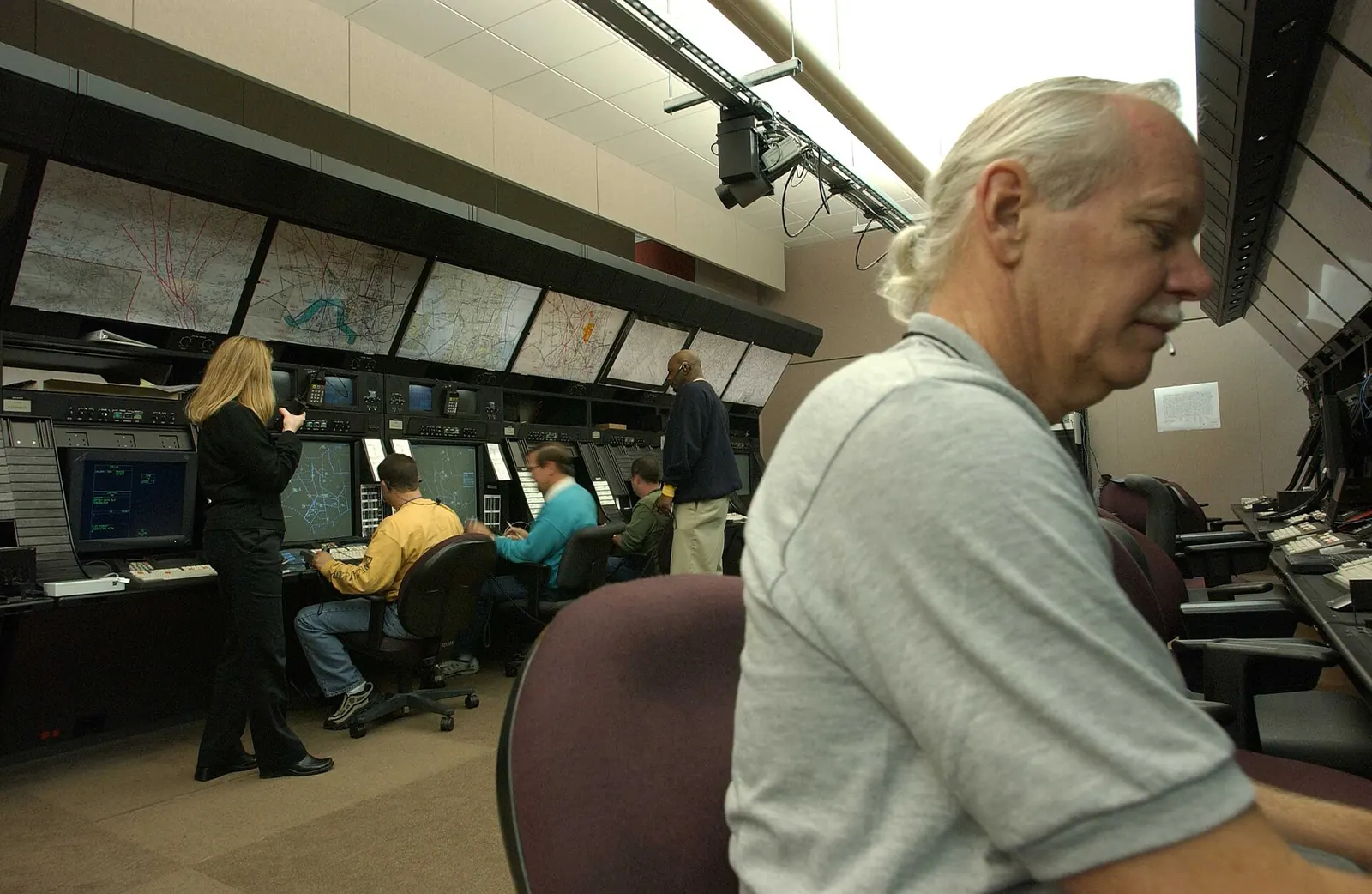
Friday afternoon, controllers at the regional centers that handle America's high-altitude traffic began losing their radars and radios in bursts. The failures were intermittent, and they were not in one place. By the time the Federal Aviation Administration concluded it could not see the edges of the problem, it did the only thing left: it stopped every departure in the United States.
The ground stop lasted about four hours, from mid-afternoon into the evening. It was the longest national halt to U.S. flight departures since September 11, 2001 — longer than the 2023 outage that took down the notice system pilots use for real-time hazards.
By 9 p.m. Eastern on Friday, more than 8,000 flights had been delayed and about 7,000 cancelled, according to FlightAware. The final Friday tally was worse: nearly 25,000 delays and more than 9,000 cancellations, with another 4,000-plus cancellations on Saturday — about 18 percent of the day's U.S. departures, per the aviation analytics firm Cirium.
The cause, as of Saturday afternoon, was still officially unknown. But the shape of it had emerged.
Transportation Secretary Sean Duffy said a contractor had been doing routine maintenance at "at least one very remote location," converting copper telephone wire to fiber optic cable. Something in that work flooded other routers in the air traffic control network. "It's pretty straightforward work that we were doing yesterday at, again, a very remote location," Duffy said. What investigators were trying to establish, he said, was "whether we had incompetence, meaning was it user error" — or whether the contractor had installed a faulty router.
His description of the equipment was blunter the night before: "We have old switches, old routers. We use 1980s little copper lines. It's an old system that went down and went down everywhere. It got overloaded," he said Friday.
FAA Administrator Bryan Bedford described the decision to ground the country in terms that were less about the failure than about the architecture: "Because of our lack of identifying the root cause, we were unwilling to take any risk that this propagation could actually result in a sensor losing connectivity with aircraft."
Read that again. The United States stopped flying not because it knew what was broken, but because it could not find out.
That is the finding of Friday, and it will outlast the investigation into which technician did what. In a network where a fault at one remote site can propagate into routers anywhere, there is no such thing as a local failure. The only containment available is national. The FAA's own administrator said so, in plain language, from a podium.
The network is not even the agency's. "Until I can build [the new architecture], I'm stuck with L3Harris, who owns this network," Duffy said. In a statement, L3Harris said it has completed more than 70 percent of the planned conversion from legacy copper wire to a fiber-optic system, and that it is supporting the FAA's investigation into what happened on Nov. 13.
Seventy percent is the reassuring number and the alarming one. The remaining 30 percent has to be cut over on live systems, one site at a time, on days when the airspace is full. Friday's work was, by the secretary's own description, uncomplicated: swap copper for glass at a remote facility. It still took the country down.
Duffy's framing is that this is a story about neglect. "Virtually every single institution in America has gone from copper to fiber, from analog to digital," he said. "Just maybe the FAA is the last one to be doing this work because the investments haven't been made, but this is not complicated."
The second half of that sentence is doing a lot of work. Running fiber is not complicated. Replacing the nervous system of the busiest airspace on earth while it is in use is a different class of problem — and the agency has been at it for years, is 70 percent of the way through, and is doing it on infrastructure it does not own and cannot fully see.
Congress approved $12.5 billion for air traffic control modernization in July 2025. Duffy is now asking for $50 billion more, and he spent Saturday's briefing weighing two explanations — incompetence or faulty equipment — before the investigation had an answer. The officials also named hardware: routers and networking gear from Cisco and L3Harris, the contractor that owns and runs the telecom backbone.
The security question was closed quickly. Homeland Security Secretary Markwayne Mullin said there was no evidence of an attack. Senator Richard Blumenthal called for a "prompt, penetrating investigation" and warned that an outage of that scale is "a clear danger to national security."
There is a newer layer here, and it explains the speed of the denials. The FAA has been rolling out an AI-assisted tool called SMART, built by Air Space Intelligence, as part of the same modernization push. Within hours of the ground stop, the company issued a statement insisting its product was not involved. It probably wasn't. But that the first question asked of a four-hour national outage was whether the new AI had done it tells you where the anxiety now sits. The agency is layering software it is still learning to trust on top of wiring it has not finished replacing, and the public has learned to suspect the newest part first.
Bedford said schedules should be back to normal by Sunday evening. That is the operational answer.
The structural one is harder. The FAA cannot stop converting copper to fiber, because the copper is the reason the system fails. But every cutover carries the same risk that materialized on Friday, and the next one will also be scheduled for a normal travel day — because there are no other kinds.
联邦航空管理局正在更换其1980年代的铜线。此次更换使全国陷入停顿。
在一个偏远的联邦航空局站点,承包商正将铜线路转换为光纤时,出现错误导致携带美国空中交通控制的数据路由器瘫痪。几小时内,全国各地的所有航班都停止了起飞。
联邦航空管理局正在更换其1980年代的铜线。此次更换使全国陷入停顿。在其中一个偏远的联邦航空局站点,承包商正将铜线路转换为光纤时,出现错误导致携带美国空中交通控制的数据路由器瘫痪。几小时内,全国各地的所有航班都停止了起飞。图片来源:美国政府公共领域,17 U.S.C. § 105 规定。
More Hourlies Stories
Content on Anagnorisis is summarized, paraphrased, and editorialized from publicly available sources for length and clarity. Original sources are linked where available. All trademarks belong to their respective owners.