Hourly ·
A Machine Proved the Riemann Hypothesis. Mathematicians Are Now the Audience.
Levent Alpöge says he and Claude found a proof of the Riemann hypothesis, and the Lean community certified it within a day. The proof is 17 million lines of formal code. The explanation would run past 250,000 pages, and he has not published it.
For 167 years the Riemann hypothesis has been the problem mathematicians agreed not to expect. On Friday it acquired a proof. By Saturday afternoon the proof had been certified by the people who maintain the machinery of formal mathematics. Almost nobody involved can yet say what it means.
Levent Alpöge, a mathematician employed by Anthropic, posted a four-page statement saying that he and Claude had found a proof of the Riemann hypothesis, and that the same method resolves the generalized Riemann hypothesis as well. He expects the extended version to follow with more time. He did not publish a paper. He published a Lean library — 17 million lines of formal code, split across fourteen downloads — and a note explaining why that was all he would release. "It being obviously inappropriate to attempt to post some massive unreadable travesty of 'slop', I decided to only present Lean," he wrote.
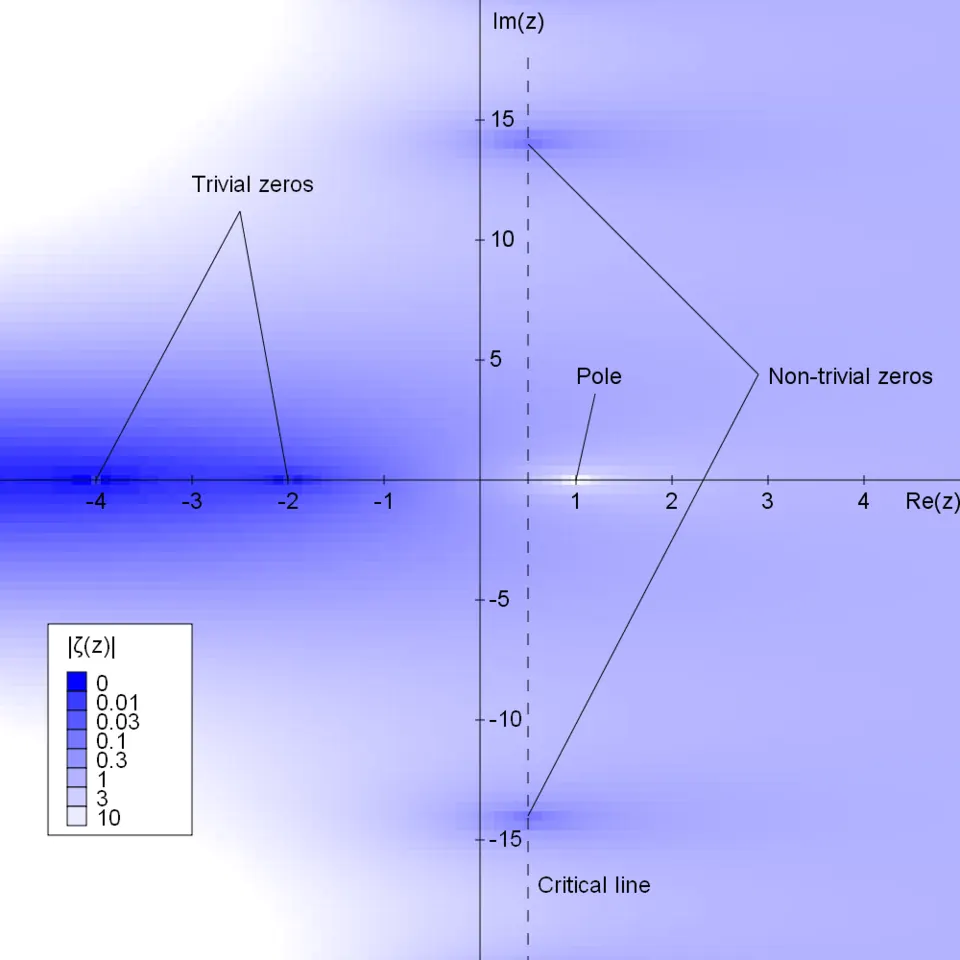
The conjecture dates to 1859, when Bernhard Riemann noticed that the irregular procession of the primes is governed by the zeros of a single complex function. If every non-trivial zero sits on the line where the real part is one-half, then the primes are distributed as evenly as they possibly can be. It is the most famous open problem in mathematics, one of the Clay Institute's million-dollar questions, and for most of the last century the standard professional position was that no path to a proof was visible.
The verification was fast and unusually thorough. The Lean and Mathlib communities issued a joint statement on Saturday, endorsed by the Lean FRO and the Mathlib Initiative, certifying that both the statement and the proof are correct. Their four criteria: the statement is Mathlib's own definition of the hypothesis, already vetted by Lean experts and number theorists; the library compiles — 175,187 modules, zero errors; an isolated file containing only the statement was compared against the proved theorem by two independent tools, both confirming they are the same proposition; and the exported proof was replayed through Lean's official kernel plus separately written checkers, including one carrying a formal proof, relative to set theory, that it cannot accept a false proof.
Andrew Sutherland's verification page at MIT logs the runs in public: every module replayed, five headline theorems depending only on the three standard axioms, an independent Rust kernel called nanoda accepting the full export in 27 minutes 42 seconds on 80 threads. The Hacker News thread on the announcement passed two thousand comments in a day, most of them arguing about what any of this is worth.
That argument is the story. A proof has always been two things at once: a guarantee that a statement is true, and an account of why. The first can now be mechanized. The second cannot. Alpöge says as much himself, in the plainest sentence in the document: "I am presenting the world with a complete argument before having mastered a massive neighbourhood around its mathematics."
He estimates that a human-readable explanation of the argument runs past 250,000 pages, and he has not released it. He says he intends to understand it, simplify it, and write it properly. Until then the mathematical community possesses a theorem it cannot teach.
The endorsements have a grammar worth noticing. Hector Pasten of the Pontifical Catholic University of Chile called the result, "if the proof is correct and understood," a dictionary between branches of math that were only partly connected — "something like a Rosetta Stone." Carlo Pagano of Concordia, visiting Google DeepMind, said that "if true," the new ideas look likely to open whole new avenues in number theory. Sutherland, who compiled the result himself, was less conditional — "the world has changed" — but added that "there is much work to be done to understand the mathematical details of the proof."
Then there is the timing, which Alpöge raises before anyone else can. He announced on Friday, one day after Anthropic's record-breaking stock market debut. He is an employee of that company, working with its model, on a result the company now has every incentive to publicize. "The precise timing is horrible," he writes. He describes finishing late on a Sunday night, messaging Dario to ask whether and when he could announce, and being told "there was a constraint to respect." He says the cynical reading is false, and he addresses it at more length than the mathematics of the announcement strictly required.
The year makes the pattern hard to miss. In July, Alpöge posted a Claude-generated solution to the Jacobian conjecture. In September, a proof of Navier–Stokes turned into a public fight between OpenAI and a New York University mathematician over credit. In October, OpenAI released hundreds of math results at once, one of which made progress on the primes. Now the oldest and hardest of them has fallen, and the person who says it fell is employed by a lab that went public the day before he said so.
What changed this weekend is not that a machine can do mathematics. It is that the discipline's scarce resource has moved. Checking a proof used to be the expensive part and understanding it was the reward. Checking is now nearly free; understanding is the whole cost. Trust has relocated too, from the referee's judgment to the kernel's exit code — which is a real guarantee, and a narrower one than it sounds. A formalization can prove the wrong statement perfectly, which is why the community built separate tools whose only job is to compare the statement to the one everyone agreed on. That step passed here. It is also the step where the entire result would fail silently.
Alpöge's statement is elegiac in places, and honest about what has been lost: "It is natural to feel that this is an end, in my case a loss of a principal guiding light." Then he calls it "one dawn across science of something far greater."
For as long as mathematics has existed, a proof was a thing a person could read and be convinced by. This one is a thing that can only be run. The theorem is settled. The mathematics is not yet understood. For the first time, those are two separate jobs, and no one has been hired for the second.
A Machine Proved the Riemann Hypothesis. Mathematicians Are Now the Audience.
Levent Alpöge 和 Claude 发现了黎曼假设的证明,并且 Lean 社区在一天内认证通过。该证明是1700万行形式代码,解释则需超过25万页,他尚未发表。
A Machine Proved the Riemann Hypothesis. Mathematicians Are Now the A Audience. Levent Alpöge 和 Claude 发现了黎曼假设的证明,并且 Lean 社区在一天内认证通过。该证明是1700万行形式代码,解释则需超过25万页,他尚未发表。对于1 167年未曾解决的问题,这次数学家们成为了观众。
More Hourlies Stories
Content on Anagnorisis is summarized, paraphrased, and editorialized from publicly available sources for length and clarity. Original sources are linked where available. All trademarks belong to their respective owners.