
Hourly ·
BepiColombo's Braking Burn Stopped at 77 Percent. Mercury Caught It Anyway.
A 37-minute braking burn ended early and the spacecraft went into safe mode. Six hours later ESA confirmed BepiColombo was in orbit around Mercury — only the second mission ever to get there, and the first caught by weak stability capture.
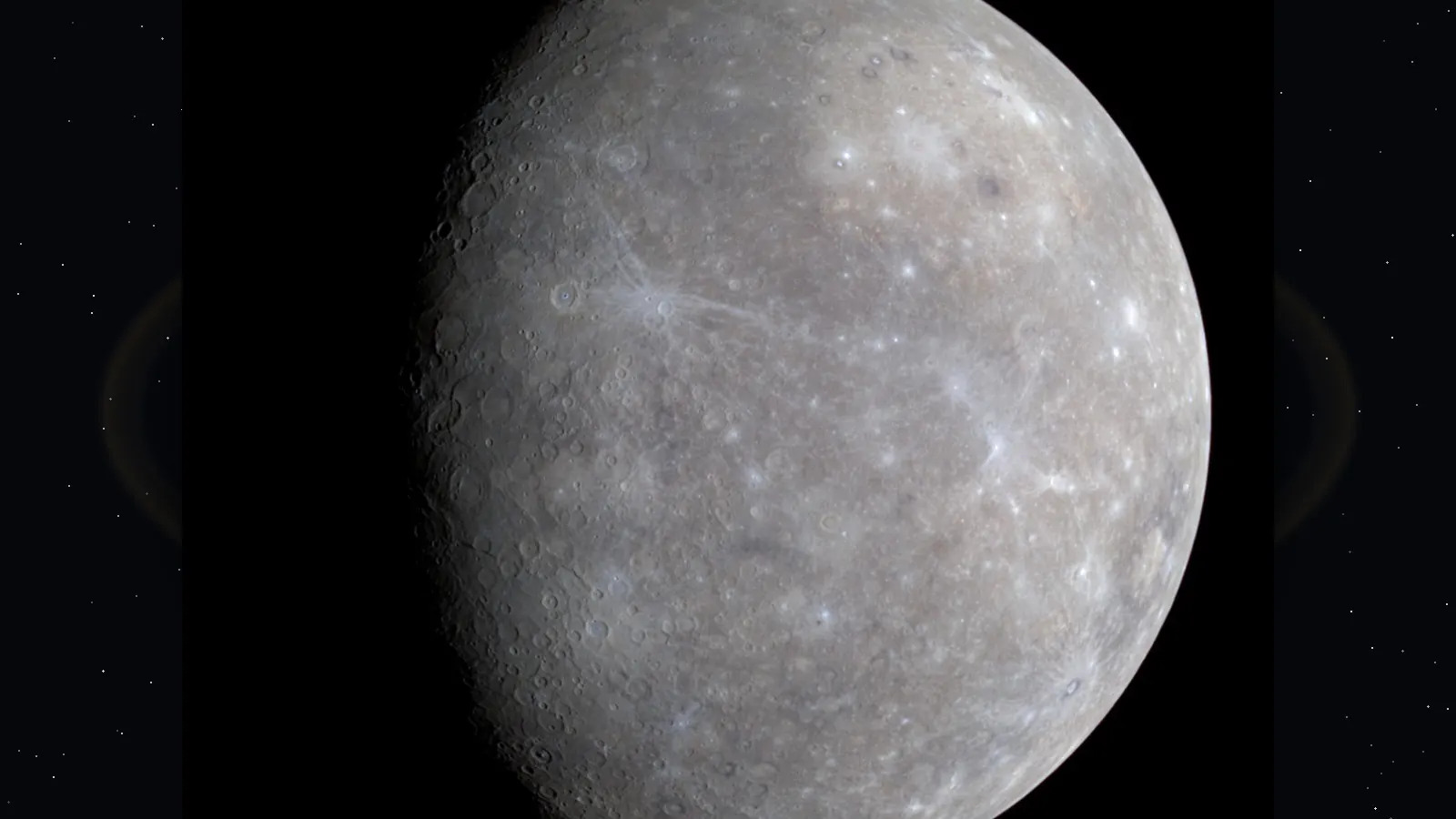
On Saturday evening, a spacecraft that had spent eight years falling toward Mercury fired four small thrusters and tried to stop.
It had 37 minutes. At 18:24 UTC, skimming 635 kilometres above a surface hot enough to melt lead, the Mercury Planetary Orbiter began the burn that would turn a temporary gravitational capture into a lasting orbit. Controllers at ESA's space operations centre in Darmstadt had watched it turn and then, as planned, lost contact. The spacecraft was on its own.
When the New Norcia antenna picked the signal up again, the burn was over and BepiColombo was in safe mode: a protective state in which a spacecraft shuts down everything it does not need. The manoeuvre had ended early. Telemetry showed the four axial thrusters had delivered about 77 percent of the planned velocity change. ESA says the fault has been traced so far to a software issue involving attitude guidance and thruster control, and the investigation is continuing.
For a while, nobody could say exactly what orbit the spacecraft was in. "Upon finding Bepi in safe mode, it was like flipping a switch. Everybody was focused in understanding what had happened," said Ignacio Tanco, ESA's flight operations director. Teams worked through the night. At about one in the morning local time, the flight dynamics team came onto the voice loop. "We confirm Mercury orbit capture!" said Frank Budnik, the mission's flight dynamics manager. The confirmation took roughly six hours from the start of the burn.
Reaching Mercury is not mainly a problem of getting there. It is a problem of arriving slowly enough to be caught. Mercury orbits 58 million kilometres from the Sun, roughly one-third of Earth's distance, and a spacecraft falling inward picks up speed it must later shed. BepiColombo did it the long way: launched in October 2018, it used solar-electric propulsion and nine planetary flybys — one of Earth, two of Venus, six of Mercury — to bend its path and arrive at a relative crawl. On Saturday it became the first spacecraft to enter orbit around another planet by "weak stability capture," a technique previously used only by some missions travelling to Earth's Moon. Weak capture alone would hold it for only a few orbits. The braking burn is what makes the orbit permanent.
The burn was meant to last 37 minutes and delivered 77 percent of its planned velocity change. The orbit it left behind is stable but wider than planned: one revolution every 75 hours instead of 58. The rest of the insertion sequence has already been adapted to the actual trajectory, with no additional burns required, and ESA says the shortfall does not affect the separation of the two science orbiters on 9 December or the MPO's ability to reach its planned science orbit.
That outcome was designed, not lucky. Mercury orbit insertion was never a single heroic burn but a series of smaller ones, each timed for the spacecraft's closest approach to the planet, each followed by a fresh measurement of the orbit before the next was planned. "The MOI sequence had been originally designed to be flexible and robust to unexpected events," Budnik said. A shortfall of almost a quarter of the planned velocity change became a wider orbit rather than a lost mission because the plan assumed shortfalls.
BepiColombo is only the second mission ever to orbit Mercury. NASA's MESSENGER circled the planet from 2011 to 2015; nothing has done it since. The new mission is two spacecraft sharing a ride: ESA's MPO, carrying eleven instruments, and JAXA's Mio, built to study the magnetosphere from a wider, more elliptical orbit.
Mercury is the least explored planet of the inner solar system and one of the strangest. It is 4,880 kilometres across, barely larger than the Moon, and by any reasonable expectation it should have cooled solid long ago. Instead it keeps a weak magnetic field generated in a partly liquid iron core — a field whose dipole is offset north by roughly 20 percent of the planet's radius, leaving the northern hemisphere far better shielded than the southern. Its surface carries "hollows," flat, kilometre-scale depressions found on no other planet, which may be forming as frozen gases escape from below. Its exosphere is comparable to a high vacuum. BepiColombo's job is to work out how the Sun's nearest planet formed, and whether it is still geologically alive.
The two orbiters separate on 9 December. Mio's sunshield is jettisoned on 16 December. MPO should reach its final orbit by March 2027, with science operations beginning in April and a mission planned to run until December 2029. "Our almost 600-strong science team will be delighted to see BepiColombo pass this key milestone and begin revealing more about Mercury, from its interior and surface to the space around it," said Geraint Jones, the mission's lead project scientist.
What happened on Saturday is the argument for building machines that can afford to fail. A burn designed for 37 minutes ended at 77 percent, and the mission went on, because the arrival had been built with slack at every stage: a capture that holds for several orbits, a sequence that re-plans after every burn, a spacecraft that met an anomaly by shutting down and waiting to be told what to do.
When something went wrong at Mercury, the first thing BepiColombo did was stop. Eight years, nine flybys, 58 million kilometres from the Sun — and the manoeuvre that mattered most was the one it did not finish.
More Hourlies Stories
Content on Anagnorisis is summarized, paraphrased, and editorialized from publicly available sources for length and clarity. Original sources are linked where available. All trademarks belong to their respective owners.