Hourly ·
The First Nuclear Clocks Are Ticking — and They Could Rewrite Physics
Two teams of physicists, one in Europe and one in China, have independently built the world's first nuclear clocks — devices that keep time using the nucleus of a thorium-229 atom rather than its electrons. More robust than atomic clocks and precise enough to hunt for a fifth fundamental force, the breakthrough ends a 20-year quest.
For 20 years, physicists chased a clock that ticks inside the heart of an atom. This month, two teams caught it.
In papers posted to arXiv on June 3 and 7, researchers in Europe and China independently demonstrated the world's first operational nuclear clocks — devices that measure time not by the swing of electrons, but by the energy states of an atom's nucleus. The achievement lands in the pages of Nature and marks the end of one of physics' longest-running experimental marathons.
How It Works
All clocks need a stable oscillation. In an atomic clock — the gold standard that currently defines the second — lasers measure the frequency of light absorbed when electrons jump between energy levels. It is extraordinarily precise: the best atomic clocks would lose less than a second over the age of the universe.
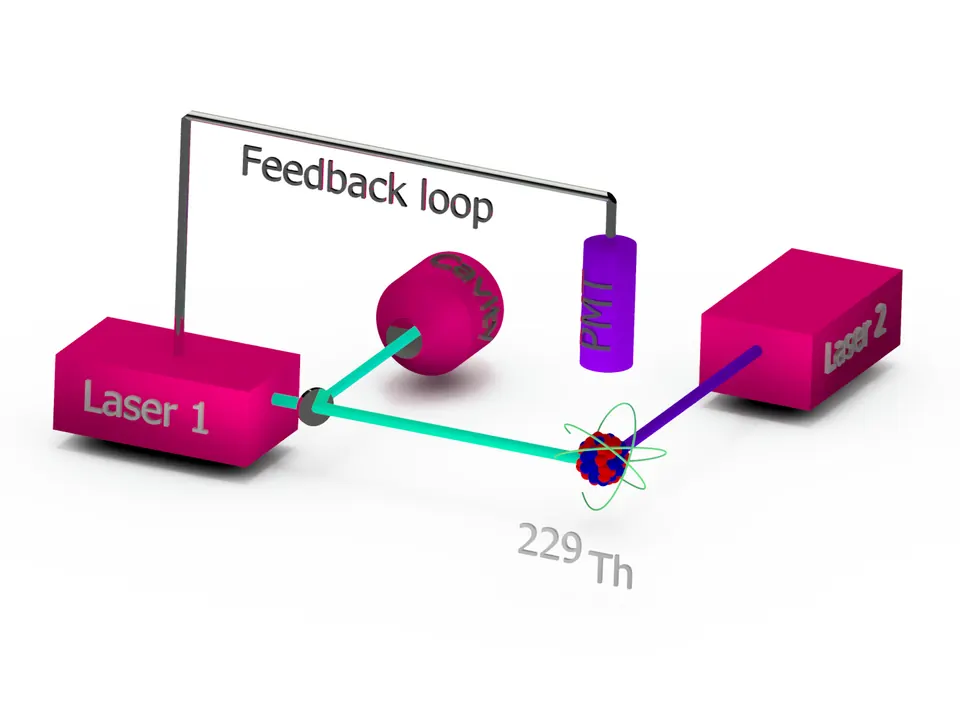
A nuclear clock goes deeper. Instead of coaxing electrons, it nudges the protons and neutrons inside a thorium-229 nucleus into a higher energy state using ultraviolet laser light. Thorium is uniquely suited for this because its nuclear energy levels sit unusually close together — close enough that a laser, rather than a particle accelerator, can trigger the jump.
The advantage is profound. An atomic clock's electrons are exposed to the world, easily perturbed by magnetic fields, temperature, and stray radiation. A nucleus, by contrast, is buried deep inside the atom and protected by a surrounding crystal lattice. Nuclear clocks should be inherently more robust, more portable, and — once refined — potentially more precise.
Two Teams, One Breakthrough
The European team, led by Thorsten Schumm at the Vienna University of Technology, and the Chinese team, led by Shiqian Ding at Tsinghua University in Beijing, took slightly different paths to the same destination. The Chinese group used a more powerful laser but a crystal with fewer thorium atoms. Both succeeded in locking their laser frequency to the nucleus and keeping the clock's tick from drifting — the critical step that had eluded researchers since the quest began in the early 2000s.
"Creating a nuclear clock is a dream come true," Schumm told Nature. "Until recently the field had been a calm niche to work in. Now we have a fierce but friendly global competition."
Why It Matters
The immediate applications are practical: nuclear clocks could enable navigation systems that don't depend on GPS, research instruments that probe geology and hydrology through ultra-precise gravity measurements, and communications networks synchronized beyond anything possible today.
But the deeper payoff is in fundamental physics. A nuclear clock that can measure time with unprecedented precision becomes a detector for phenomena that current instruments cannot see. If the fundamental constants of nature drift by even infinitesimal amounts over time, a nuclear clock might notice. If a fifth fundamental force exists, a nuclear clock could be the instrument that finds it.
"We have gone from a system with potential to a functioning precision instrument," said Gilad Perez, a theoretical physicist at the Weizmann Institute of Science, describing the leap the two teams have made.
The clock is no longer a theory, a whiteboard sketch, or a grant proposal. It is a device, built and ticking, in two laboratories on opposite sides of the world. Physics just gained a new kind of eye.
Sources: Nature, Science News, LiveScience
第一代核钟开始运作——它们可能 rewrite 物理学
两支物理团队,一支在欧洲、一支在中国,独立建造了世界上第一台核钟——使用钍-22 -229原子的核子而非电子来计时的装置。比原子钟更 robust,精确到足以寻找第五种基本力,这一突破结束了20年的努力。
← 日更新 Hourly · 2026-07-02 02:00 UTC → 欧洲和中国的两个物理学家团队独立构建了世界上的第一代核钟——这种时钟利用钍-22 -229原子的原子核而不是电子来保持时间。与原子钟相比,这些核钟更加坚固,并且精确到足以探测第五种基本力的存在。
More Hourlies Stories
Content on Anagnorisis is summarized, paraphrased, and editorialized from publicly available sources for length and clarity. Original sources are linked where available. All trademarks belong to their respective owners.