
Hourly ·
Solar Storm Hits Earth: CME Triggers G1 Geomagnetic Storm, Auroras Possible
A minor but well-aimed coronal mass ejection from the Sun reached Earth on August 7, triggering a G1-class geomagnetic storm. NOAA and spaceweather.com confirmed the impact, with auroras visible in high-latitude regions including northern Michigan and Maine.
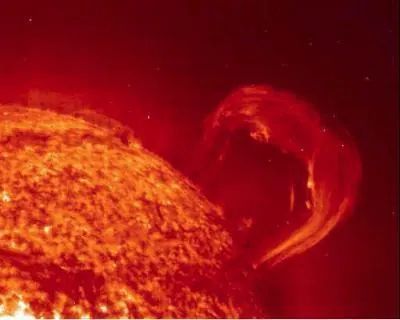
A coronal mass ejection (CME) that erupted from the Sun on Monday, August 3, reached Earth on Friday, August 7, triggering a G1-class (minor) geomagnetic storm, according to NOAA's Space Weather Prediction Center and spaceweather.com.
The CME was described as "minor but well-aimed" by spaceweather.com, which forecast the impact could spark auroras at high latitudes. NOAA's WSA-Enlil model confirmed the Earth-directed trajectory of the plasma cloud.
What Happened
CMEs are large explosions of charged plasma and magnetic fields from the Sun's corona. This particular CME traveled at moderate speed — taking roughly four days to cross the 150 million kilometers between the Sun and Earth. The fastest CMEs can make the journey in as little as 15 hours.
When CMEs slam into Earth's magnetosphere, they disturb the planet's magnetic field, causing geomagnetic storms classified on NOAA's G1 through G5 scale. G1 storms, like this one, typically cause weak power grid fluctuations and minor impacts on satellite operations.
Where to See Auroras
The storm energized nitrogen and oxygen particles in Earth's upper atmosphere, potentially producing northern lights visible in high-latitude regions. Forecasters predicted aurora visibility in areas like northern Michigan and Maine. G1 storms generally keep the light show confined to higher latitudes, unlike stronger G3-G5 events that can push auroras as far south as Illinois or Oregon.
Solar Activity Context
The Sun is currently near the peak of its 11-year solar cycle (Solar Cycle 25), which has produced more frequent flares and CMEs throughout 2026. Earlier this year, multiple G3 and G4 storms brought auroras to unusually low latitudes across the United States and Europe.
Skywatchers hoping to catch future displays should monitor NOAA's 3-day space weather forecast and the planetary K-index, which measures geomagnetic activity in real time. A Kp value of 5 or higher typically indicates visible auroras at mid-latitudes.
Sources: Starlust, Spaceweather.com
太阳风暴袭击地球:CME引发G1 geomagnetical暴风雨,极光可能来临
一次微小但精准的日冕物质抛射于8月7日抵达地球,引发了一级geomagnetic暴。NOAA NOAA和spaceweather.com确认了这一影响,在北极地区包括密歇根州北部和缅因可见极光。
← Hourlies Hourly · 2026-08-08 04:00 UTC 太阳风暴袭击地球:CME引发G1级 geom geomagnetic暴,极光可能可见。 日本时间8月7日,太阳释放了一次小型但精准的冕状物质喷发(coronal mass ejection, CME),它已经抵达地球并引发了G1级别的geoma geomagnetic暴。美国国家海洋和大气管理局(NOAA)以及spaceweather.com证实了这一影响,并指出极光在高纬度地区如北密歇根州和缅因州等地可见。 图片:NASA/ESA NASA/ESA 公共
More Hourlies Stories
Content on Anagnorisis is summarized, paraphrased, and editorialized from publicly available sources for length and clarity. Original sources are linked where available. All trademarks belong to their respective owners.