Hourly ·
NASA Launches Last-Minute Robot to Catch Falling Space Telescope
A NASA-funded robot launched Friday on a first-of-its-kind mission to catch the 22-year-old Swift space telescope mid-orbit and boost it to safety before it burns up in Earth's atmosphere.
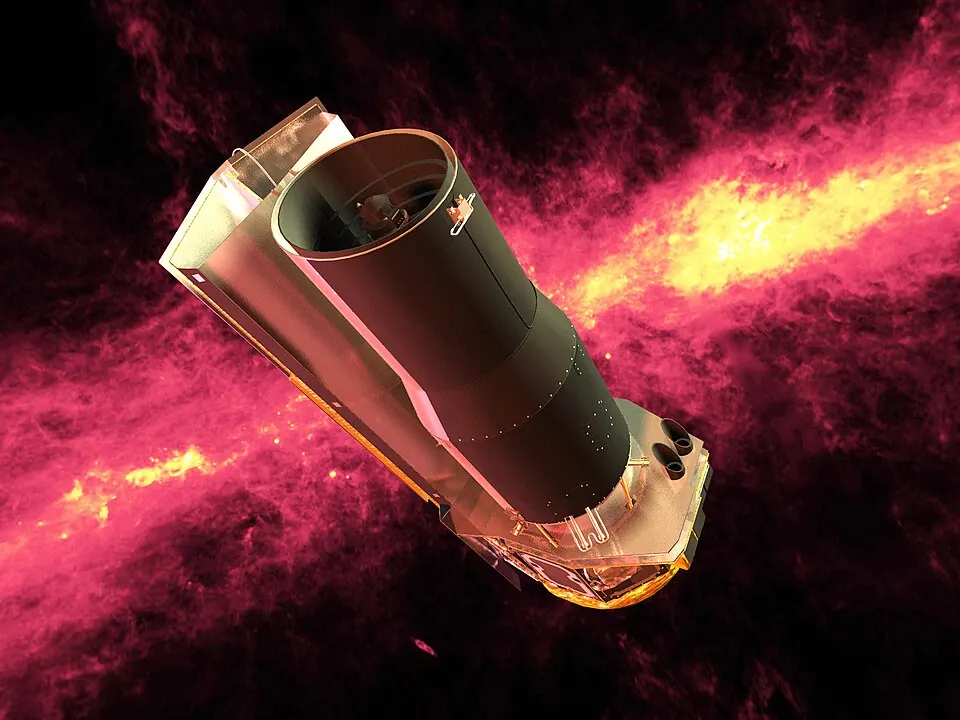
A fridge-sized robot with three arms is now racing through space to save one of humanity's most valuable science instruments from a fiery death.
The LINK spacecraft, built by Flagstaff-based startup Katalyst Space Technologies, launched Friday aboard a Northrop Grumman Pegasus XL rocket. Its mission: intercept the Swift Gamma-Ray Burst Observatory, which has been slowly falling toward Earth for two years, and push it back to a safe orbit before it's too late.
Swift has been studying the most violent explosions in the Universe since 2004. Gamma-ray bursts — the final, cataclysmic deaths of giant stars and the collisions of their stellar corpses — release in seconds the same energy the Sun will emit over its entire 10-billion-year lifetime. No other instrument can study them the way Swift can. "There is nothing like Swift," NASA concluded, "and it is a spacecraft worth saving."
But the observatory is in trouble. Increased solar activity has puffed up Earth's atmosphere, dragging on Swift and lowering its orbit from 373 miles to roughly 220 miles. Below 186 miles, rescue becomes impossible. The window is closing fast.
Enter Katalyst. The Arizona startup had less than a year to design, build, test, and launch a robotic spacecraft capable of doing something nobody has ever attempted: catching an uncontrolled satellite in orbit and boosting it to safety. "What the Katalyst team has accomplished in just eight months is extraordinary," said CEO Ghonhee Lee. "The team designed, built, tested, and integrated a robotic spacecraft capable of performing one of the most ambitious commercial servicing missions ever attempted."
The rescue won't be quick. LINK will spend the next few weeks waking up its systems one by one — power, navigation, cameras, sensors — checking that each survived the ride. Then it must home in on a moving target whose altitude shifts week by week. It will circle Swift, photograph it from every angle, and identify a safe place to grab hold. Then the three robotic arms will latch on and fire thrusters to lift the $500 million telescope back to a stable orbit.
"Swift was never designed to be caught in space," said Dr Simeon Barber, a space scientist at the Open University. "This is high risk. But NASA obviously thinks it's worth a go."
If LINK succeeds, it opens the door to on-orbit servicing and rescue missions for the hundreds of aging satellites currently drifting toward the atmosphere. If it fails, a uniquely capable observatory — one that has peered into the dawn of the cosmos for 22 years — becomes a shooting star.
Sources: BBC News, Katalyst Space Technologies
NASA 发射 最后时刻 机器人 捕捉 下坠 的 太空 台座
一个NASA资助的机器人周五首次执行任务,发射去拦截22岁的Swift太空望远镜并在其坠入地球大气层前将其提升到安全位置。
### 每日动态 · 2026-07-03 12:00 UTC NASA发射最后一分钟机器人以接住坠落的太空望远镜 美国国家航空航天局(NASA)周五发射了一架前所未有的机器人,旨在执行一项任务,将坠入轨道中的22岁Swift太空望远镜接住,并将其提升至安全高度,以防它在地球大气层中燃烧殆尽。 图像:NASA/JPL-Caltech,公共领域(许可) 一台与冰箱大小相当的机器人配备了三只手臂,现在正在竞速前往目标。
More Hourlies Stories
Content on Anagnorisis is summarized, paraphrased, and editorialized from publicly available sources for length and clarity. Original sources are linked where available. All trademarks belong to their respective owners.