Hourly ·
NTU Builds a Diving Suit for Cyborg Cockroaches — They Worked Underwater for 3 Hours
Researchers at Nanyang Technological University in Singapore have 3D-printed a wearable diving suit for cyborg cockroaches, enabling them to breathe and move underwater for up to three hours — turning the remote-controlled insects into amphibious search-and-rescue robots.
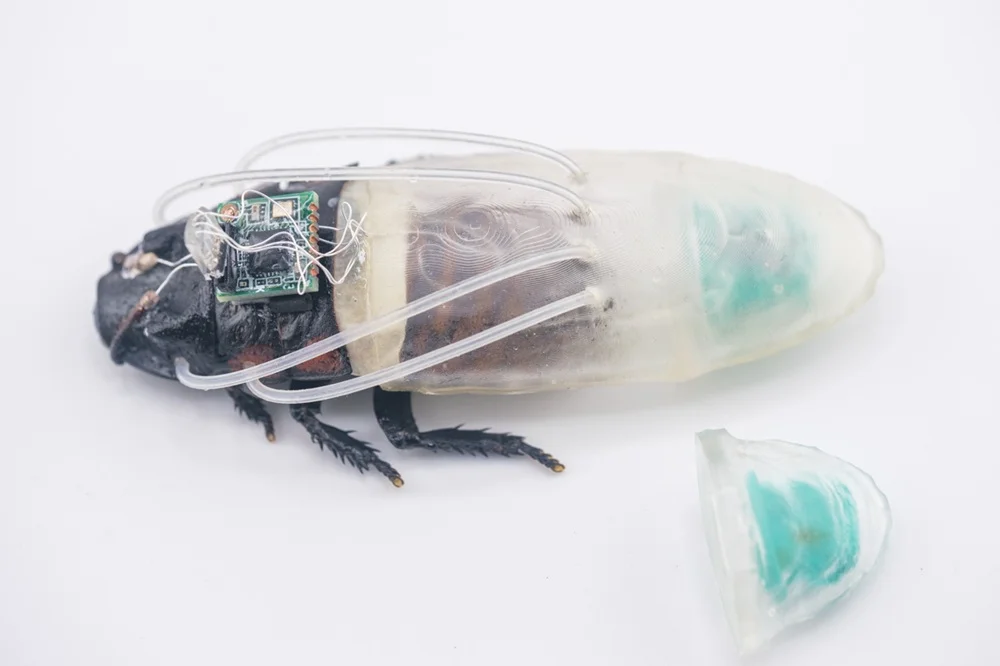
The next time someone gets trapped in a flooded cave, the rescuer crawling through the rubble might not be human. It might be a mind-controlled cockroach wearing a tiny scuba tank.
Researchers at Nanyang Technological University in Singapore have 3D-printed a flexible diving suit that turns terrestrial cyborg cockroaches into amphibious rescue robots. The suit — worn like a backpack — houses a chemical oxygen generator that pumps breathable air through tubes connected to the insect's spiracles, the openings it uses to breathe. In tests, the outfitted roaches survived and moved underwater for up to three hours.
The work, published this week in Nature Communications, solves a fundamental limitation that has kept cyborg insects landlocked. For over a decade, researchers have been attaching electrodes to cockroaches' brains and sensory organs, creating remote-controlled bugs that can be steered through rubble and narrow gaps for search-and-rescue operations and pipeline inspections. But until now, these biohybrid robots stopped working the moment they hit water.
"By fitting a cockroach, which is a terrestrial species, into this diving suit, we allowed it to survive and operate in oxygen-deprived environments," the research team led by Professor Hirotaka Sato wrote, "transforming it into an amphibious cyborg robot capable of operation across land and water."
The cyborg approach has distinct advantages over traditional robots. Because the insect handles its own locomotion, it requires far less computing power and carries no heavy battery or motors — crucial in disaster scenarios where every gram matters. The operator only nudges the roach's direction when it strays off course; the insect's natural autonomy handles obstacle navigation on its own.
The Singapore team says the same principle could eventually apply to other oxygen-deprived environments — including space.
Sources: Nature Communications | Popular Science | SMBtech
.ntu建造了水下昆虫 cyborg 的潜水服—它们在水中工作了3个小时。
南洋理工大学的研究人员在新加坡利用3D打印技术制造了一种可穿戴潜水服,使蟑螂昆虫能够在水中呼吸和移动长达三小时——将远程控制的昆虫变成两栖搜索与救援机器人。
← 周报 Hourlies · 2026-07-03 08:00 UTC NTU 建造水下机器蟑螂的潜水服 — 它们在水中工作了三小时 现今新加坡南洋理工大学的研究人员使用三维打印技术制造了一款可穿戴式潜水服给水下机器人蟑螂,使其能够在水中长达三个小时呼吸和移动——让这些由远程控制的昆虫变成两栖搜索救援机器。 I
More Hourlies Stories
Content on Anagnorisis is summarized, paraphrased, and editorialized from publicly available sources for length and clarity. Original sources are linked where available. All trademarks belong to their respective owners.