
Hourly ·
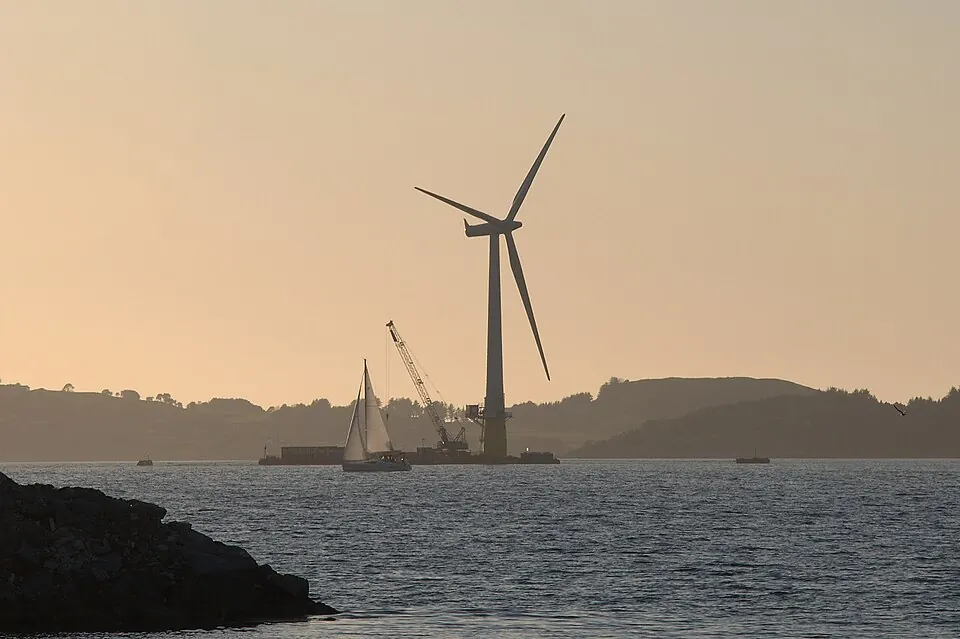
China Just Anchored the World's Largest Floating Wind Turbine in Typhoon Alley
A 16 MW monster with a 252-meter rotor is now spinning 70 km off Guangdong — proof that deep-water wind is no longer theoretical.
The deep ocean just became a power plant.
On May 2, China Three Gorges Corporation installed the world's largest single-unit floating offshore wind turbine in more than 50 meters of water, roughly 70 kilometers off the coast of Guangdong Province. The 16 MW "Three Gorges Pilot" platform isn't just big — it's a structural argument that floating wind can survive where fixed-bottom turbines cannot.
The numbers are staggering. The semi-submersible hull stretches 91 meters across and displaces 24,100 tonnes. Its rotor sweeps a 252-meter circle — wider than two football fields. Annual output is projected at 44.65 gigawatt-hours, enough to supply 24,000 households. Cost per kilowatt has fallen more than 50% compared to China Three Gorges' earlier floating unit from 2021, while output nearly triples.
But the real flex is where it's built. The platform is rated for super-typhoon conditions: wave heights above 20 meters and wind speeds up to 73 meters per second. That's a structural data point the global floating wind industry has been waiting for. European developers targeting turbines in the 15 to 18 MW range for their first commercial-scale floating projects now have verified performance data from a unit operating in conditions harsher than the North Sea.
Four systems debut in China's offshore sector with this install: an active ballast arrangement that redistributes water across three column tanks to stabilize the hull under wave loading, nine suction anchors holding the platform via polyester mooring lines each rated to 1,300 tonnes of tensile load, and a domestically developed 66 kV submarine cable engineered for continuous cyclic stress.
Analysts caution that China's subsidized fabrication base and domestic content requirements complicate direct cost comparisons with European supply chains. But the engineering signal is clear: the deep ocean is now a viable address for wind at scale.
The platform is not a prototype. It's connected, generating, and gathering data. The question is no longer whether floating wind works — it's who scales it first.
Sources: Floating Offshore Wind Conference, LiveScience
中国就在台风 alley 抛下世界最大的浮动风力涡轮机
一个16兆瓦的怪物,拥有252米的叶轮,现在已经在广东南部70公里外旋转——证明深海风电不再是理论。
### 海报·今日快报 · 2026-07-01 02:00 UTC 中国已在台风 Alley 中成功安装了世界上最大的浮动风力涡轮机。一个功率高达16兆瓦、叶轮直径达252米的庞然大物现在在广东海域70公里外开始旋转——证明深海风电不再是理论范畴。深海水域已经变成了发电站。5月2日,中国三峡集团成功安装了世界上最大的单个单元浮动风力涡轮机。
More Hourlies Stories
Content on Anagnorisis is summarized, paraphrased, and editorialized from publicly available sources for length and clarity. Original sources are linked where available. All trademarks belong to their respective owners.