Hourly ·
What Will Be Left For Us to Work On? Princeton Professor's ICML Keynote Tackles AI Job Anxiety
Arvind Narayanan's ICML 2026 keynote challenges binary AI narratives, proposing co-superintelligence as the path forward for human-AI collaboration.
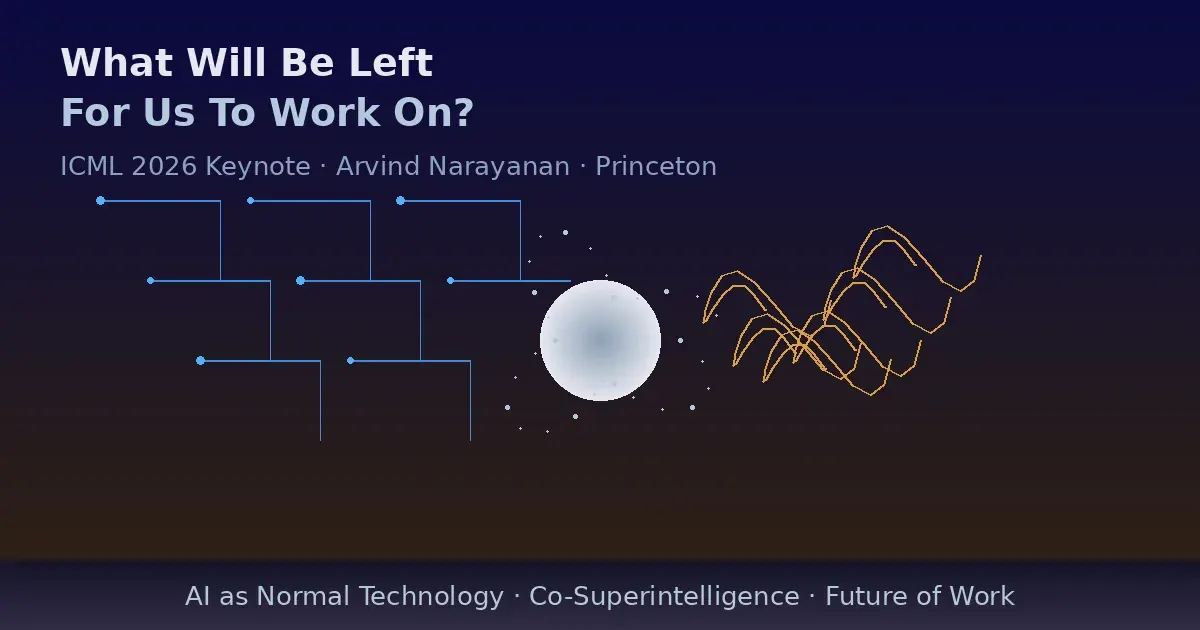
Arvind Narayanan, the Princeton computer scientist known for co-authoring the influential "AI as Normal Technology" framework, delivered a keynote at the 2026 International Conference on Machine Learning in Seoul last week that confronted the question haunting the AI community: what happens to human work when AI can do more and more of what we do today?
The talk, titled "What will be left for us to work on?", made three core arguments. First, the "AI as Normal Technology" framework — which treats AI as a tool that follows familiar patterns of technological adoption rather than an unprecedented disruption — remains the correct lens, "unless and until there is some future discontinuity such as through recursive self-improvement."
Second, even taking recursive self-improvement seriously, "there is no milestone that companies might achieve in the lab that will suddenly put us all out of work." The gap between capability benchmarks and real-world deployment turns out to be wide, and Narayanan's team at Princeton has been building evaluation methods that measure factors beyond raw benchmark scores — cost, reliability, integration friction, and organizational readiness.
Third, jobs of the future "will be radically different, and a lot of adaptation will be needed." Narayanan ended with a vision he calls "co-superintelligence" — humans and AI systems working together in ways that amplify rather than replace human intelligence.
The keynote arrives at a moment of heightened anxiety. Narayanan noted that if the AI research community "simply rolls over and accepts that a lot of our work will be done by AI in the future, instead of setting clear boundaries," it will fuel a stronger political backlash against the technology. "The whole world is watching," he said.
Narayanan's framework pushes back against the binary narratives — utopian automation on one side, mass obsolescence on the other — and instead argues for a messy, negotiated middle where AI changes work rather than eliminates it. The slides and annotated transcript are available on his Substack, NormalTech.
Sources: NormalTech, ICML 2026 Schedule
人工智能带来就业焦虑?普林斯顿教授ICML keynote探讨
阿文德·纳亚nanan在ICML 2026的主旨演讲挑战了二元AI叙事,提出共超智能作为人类与人工智能协作的前进之路。
### 哨兵新闻 · 2026-07-14 08:00 UTC 什么将留给我们将要工作?普林斯顿教授在I ICML大会上的主旨演讲探讨了人工智能就业焦虑问题 阿文迪·纳亚南教授在ICML 2026大会上的主旨演讲挑战了一刀切的人工智能叙事,提出了人类与AI协作的前进道路——共超级智能。阿文迪·纳亚南是普林斯顿计算机科学家,以其共同撰写的具有影响力的《AI as Nous》而闻名。 ### 阿里云提示 请注意:由于输入的文本较长且包含格式信息,这里的翻译保留了原文的大致结构,并进行了必要的调整以符合中文的表达习惯。在实际使用时,根据需要可以进一步精简和润色。
More Hourlies Stories
Content on Anagnorisis is summarized, paraphrased, and editorialized from publicly available sources for length and clarity. Original sources are linked where available. All trademarks belong to their respective owners.