Hourly ·
World-First 'Super Alloy' Achieves Twice the Strength of Steel Through Atomic Self-Organization
An international team has created a refractory high-entropy alloy that self-organizes into defect-free atomic structures, reaching over 2 gigapascals of compressive yield strength — double what conventional processing achieves.
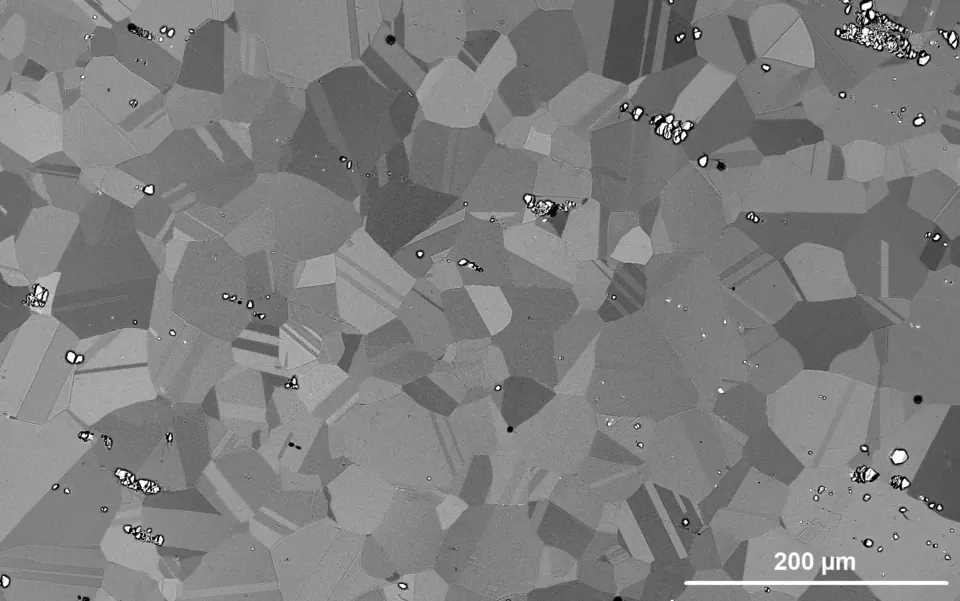
An international team led by Monash University and Chongqing University has created a "super alloy" that derives its extraordinary strength not from exotic ingredients, but from letting atoms organize themselves during manufacturing.
The alloy, a mix of hafnium, niobium, tantalum, titanium, and zirconium, undergoes a brief high-temperature melt before being held at just 550°C for 32 hours. The result is a Refractory High-Entropy Alloy (RHEAD) whose atomic grains pack so tightly and orderly that it reaches compressive yield strength above 2 gigapascals — twice as strong as steel and three times stronger than aluminum — while remaining ductile enough to bend without fracturing.
"For more than a century, alloy development has focused on composition and processing," said Jian-Feng Nie, a materials scientist at Monash University. "Our work suggests that how atoms organize during manufacturing may be just as important."
The same five-metal mix processed conventionally delivers half the strength. The key difference: the low-and-slow approach gives atoms time to self-correct into defect-free repeating patterns across the entire bulk material — a phenomenon previously demonstrated only in thin films or microscopic samples.
"Instead of increasing alloy content to achieve better performance, we may be able to design internal structures that deliver superior properties with fewer alloying elements," said Yu Zhang from Chongqing University. "That could lead to more efficient, sustainable, and cost-effective alloy production."
The research was published in Science (Zhang et al., 2026, doi:10.1126/science.aec4995).
Sources: ScienceAlert
Note: The original Science paper and Monash University press release are behind institutional access walls. ScienceAlert provides open-access reporting of the full study.
世界首个“超级合金”通过原子自组织实现钢两倍的强度
一个国际团队创建了一种自组织成无缺陷原子结构的耐火高熵合金,其压缩 Yield 强度超过2吉帕斯卡——这是常规加工所能达到强度的两倍。
Hourlies Hourly · 2026-07-14 04:00 UTC 国际团队开发出具有“超强合金”特性的高熵合金,通过原子自组织形成无缺陷的结构,其压缩屈服强度超过2吉帕斯卡——是传统处理能力的两倍。 图片:Ewint6,CC0( lice
More Hourlies Stories
Content on Anagnorisis is summarized, paraphrased, and editorialized from publicly available sources for length and clarity. Original sources are linked where available. All trademarks belong to their respective owners.