
Hourly ·
Scientists Discover a Mysterious Decagon-Shaped Wave Over Saturn's South Pole
A giant ten-sided atmospheric pattern has emerged over Saturn's south pole — bigger and stranger than the famous northern hexagon, and no one can explain why.
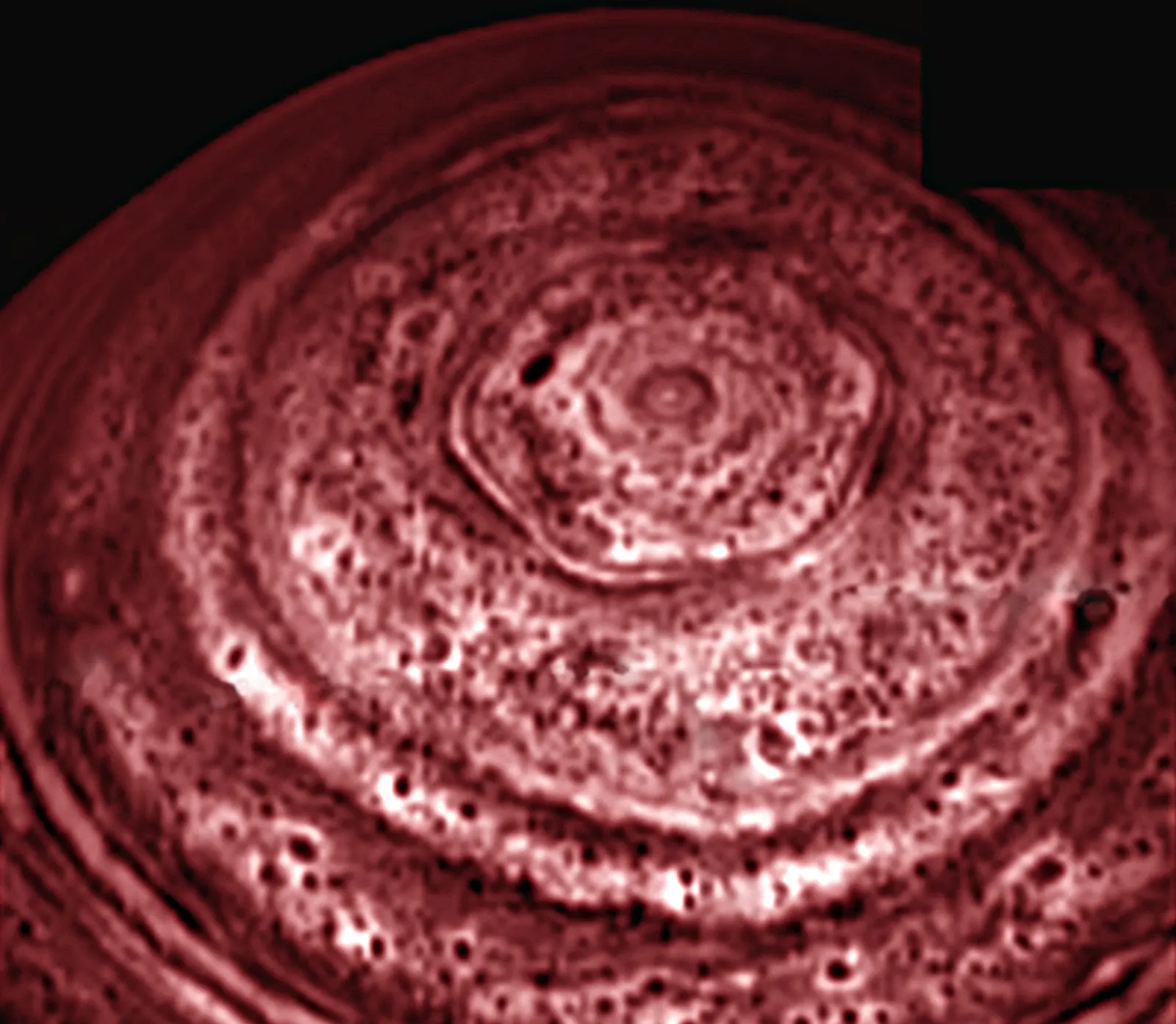
Astronomers have spotted something uncanny swirling over Saturn's south pole: a giant ten-sided wave of cloud — a decagon — that no one can yet explain. The geometric structure, revealed in Hubble Space Telescope images, is the first polygon ever seen at the planet's southern pole, and it appears to have formed only recently.
The finding, published Wednesday in Science Advances, was led by Agustín Sánchez-Lavega of the University of the Basque Country. The decagon is a surprise because Saturn already hosts a famous polygon at its north pole — a stable hexagon known since NASA's Voyager flybys in the 1980s. The new southern decagon looks even bigger than that hexagon, with a single side already stretching more than 16,700 kilometers.
Unlike the long-stable northern hexagon, the southern decagon is actively changing. It drifts eastward at a gentle 6 mph (10 km/h) and only began to show itself in Hubble images from 2023, sharpening into a clear ten-sided shape by August and September 2025. Researchers think it may have formed between 2017 and 2023, while Saturn's south pole was tilted away from Earth and out of view.
'We've never seen anything quite like this in Saturn's southern hemisphere,' said co-author Amy Simon of Hubble's OPAL program. 'This feature is different — it appears to be strengthening, giving us the rare opportunity to watch a giant atmospheric pattern form.' Sánchez-Lavega suspects the shape may stem from an instability in the jet stream where it sits, or a wave forced from deeper levels of the atmosphere. 'Saturn still has the ability to surprise us,' added the University of Leicester's Leigh Fletcher, who measured the winds with the Very Large Telescope in Chile. By comparing the two poles, scientists hope to learn how weather works on giant planets.
Sources: Scientific American, Science News, ScienceAlert, Gulf News
科学家发现 Saturn 南极出现了一个神秘的十边形波形
一个巨大的十边形大气模式已在土星南极出现——比著名的北极六边形更大更奇怪,且没有人能解释其原因。
← 小時報 小时报 · 2026-09-03 00:00 UTC 科学家发现土星南极出现一个神秘的十边形波纹 大型十边形大气模式在土星南极上空浮现——比著名的北极六角形更大更奇异,而且无人能解释其原因。天文学家已注意到一种奇特的旋涡正在土星南极上空旋转:一个巨大的十边形波动。
More Hourlies Stories
Content on Anagnorisis is summarized, paraphrased, and editorialized from publicly available sources for length and clarity. Original sources are linked where available. All trademarks belong to their respective owners.