Hourly ·
Nanoscale Ridges Give Superconductors a 15-Kelvin Boost
Swedish researchers sculpted the surface beneath an ultrathin superconductor and unlocked higher temperatures and record magnetic-field resilience — a new paradigm for ultra-efficient electronics.
Superconductors can carry electricity with zero resistance, but they come with two stubborn demands: extreme cold and magnetic-field fragility. A team at Chalmers University of Technology in Sweden just found a way to push back on both fronts — not by changing the superconductor itself, but by sculpting the surface it sits on.
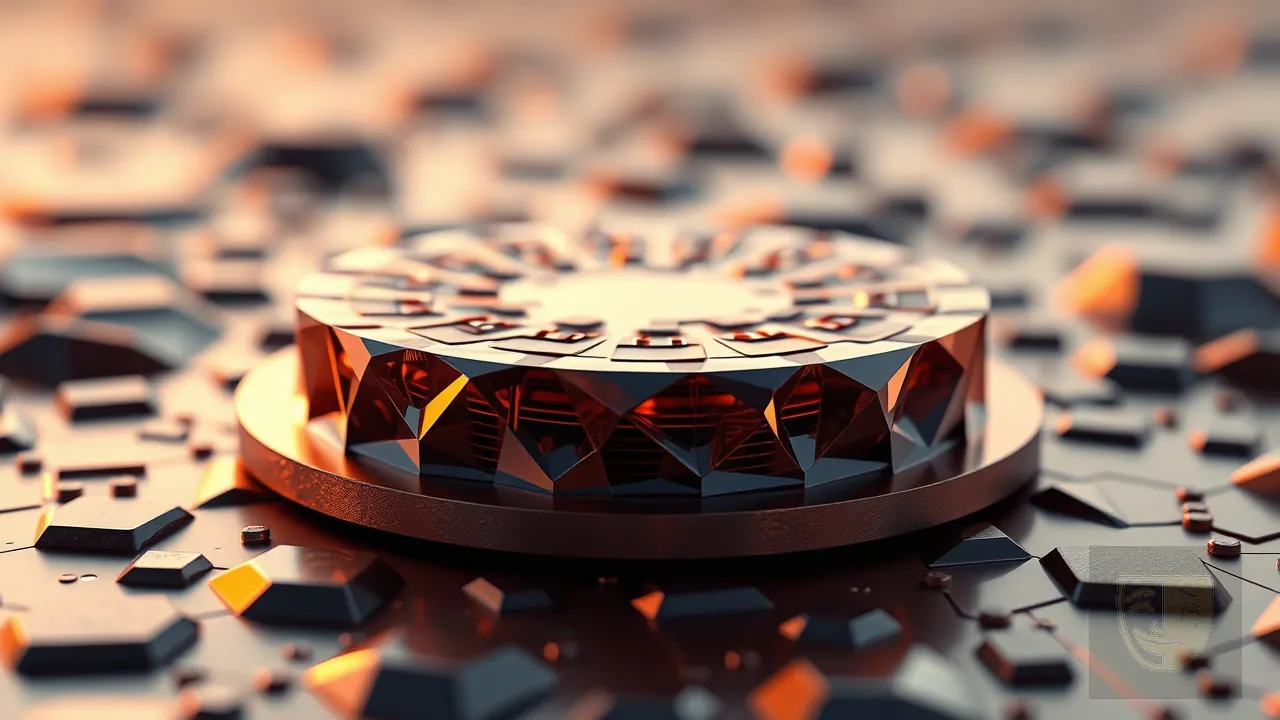
Led by Professor Floriana Lombardi, the researchers grew an ultrathin film of yttrium barium copper oxide (YBCO) — a cuprate superconductor — on a magnesium oxide substrate that had been annealed at high temperature in a vacuum. That treatment created a landscape of nanoscale ridges and valleys. When the superconducting film was deposited on this "nanofaceted" surface, something remarkable happened: the onset temperature for superconductivity jumped by 15 kelvin, and the upper critical magnetic field climbed by 50 tesla.
By contrast, identical YBCO films grown on smooth strontium titanate substrates showed no enhancement at all — confirming that the substrate topography, not the film chemistry, was the active ingredient.
The physics behind the boost is subtle but powerful. In standard cuprates, competing electronic patterns called charge density waves suppress superconductivity, particularly at certain doping levels. The nanofaceted surface appears to suppress those charge density waves while introducing electronic nematicity — a directional preference in the electron fluid — that stabilizes the superconducting state at the interface.
"Instead of searching for entirely new materials or manipulating the chemical properties of existing ones, we are now showing how superconductivity can be enhanced by sculpting the substrate," Lombardi said.
The implications reach far beyond the lab bench. Digital devices, data centers, and ICT networks currently consume an estimated 6 to 12 percent of global electricity. Superconducting electronics could slash that figure — if the materials can operate at practical temperatures and survive real-world magnetic environments. This substrate-engineering approach opens a new design axis that could eventually bring superconductors closer to room-temperature operation.
The work, published in Nature Communications, involved collaborators from RISE Research Institutes of Sweden, Ca' Foscari University of Venice, the Indian Institute of Science Education and Research, Uppsala University, and several French institutions.
Sources: Chalmers University, Nature Communications, R&D World, ScienceDaily
纳米级凸起为超导体带来15开尔文的提升
瑞典研究人员在超薄超导体下方雕刻表面并解锁了更高温度和记录级别的磁性耐受性— ——一种新的高效电子学新范式。
### 周刊周刊 · 2026-06-29 22:00 UTC 半导体纳米槽纹为超导体提供15开尔文的提升 瑞典研究人员在一种极其薄的超导体表面下方雕刻出了新的格局——这带来了更高的温度和记录级别的磁场耐受性——一个新的高效电子学新范式。 超导体可以零电阻传导电能,但它有两大顽固的需求:极高温度下保持超导状态,并且在高磁场环境中稳定工作。
More Hourlies Stories
Content on Anagnorisis is summarized, paraphrased, and editorialized from publicly available sources for length and clarity. Original sources are linked where available. All trademarks belong to their respective owners.