Hourly ·
JWST Reveals a Universe That Shouldn't Exist — Black Holes Too Big, Galaxies Too Bright
The James Webb Space Telescope keeps finding ancient black holes and galaxies that defy established astrophysics. After four years of observations, scientists now have too many competing theories to explain what they see.
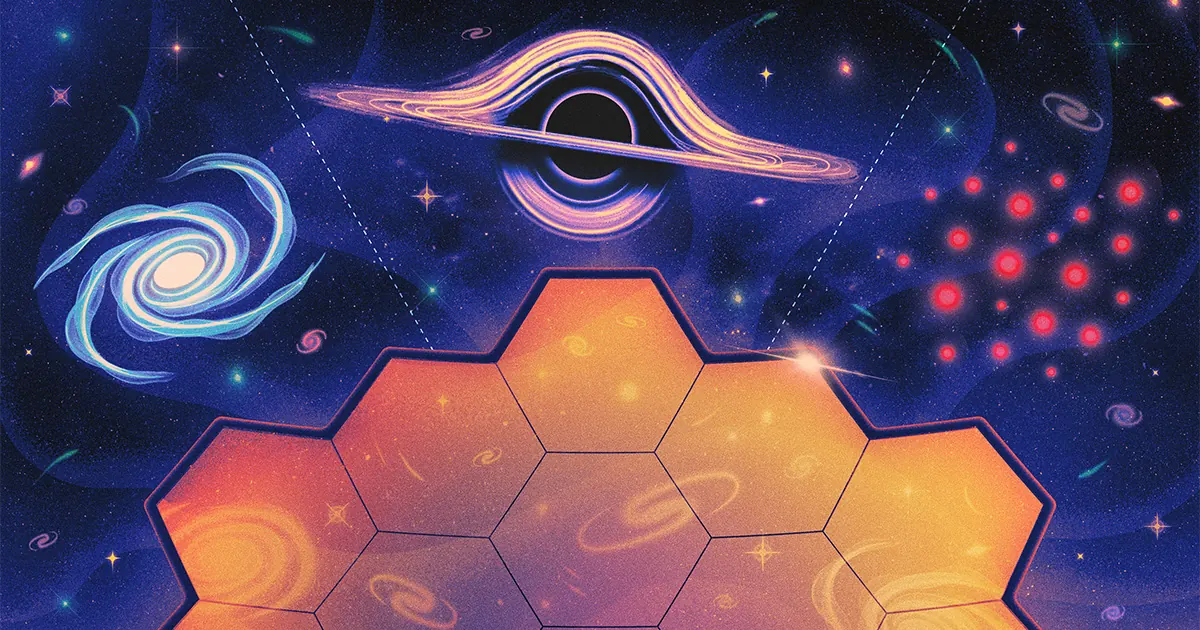
When Charlotte Mason ponders cosmic mysteries, she likes to doodle. The astrophysicist at the Cosmic Dawn Center in Copenhagen has been filling pages with sketches of "little red dots" — perplexing objects discovered by the hundreds in JWST images, appearing roughly 650 million years after the Big Bang. These dots were never seen before the telescope came online in 2022.
Now, after four years of observations, the universe revealed by JWST simply doesn't square with our understanding of astrophysics. Black holes that seem impossibly large for their age. Ancient galaxies far too bright to exist so soon after the Big Bang. "We almost have gone from having too many early galaxies to having too many theories to explain them," said Rachel Somerville of the Flatiron Institute.
Recent ideas suggest the little red dots could be black holes cocooned in thick gas — possibly a completely new type of object called a black hole star. Others point to "super-Eddington" accretion, where black holes consume matter at rates that break classical limits. Still others invoke "direct collapse," where colossal gas clouds plunge straight into black holes without forming stars first.
"In order to get them that big so quickly, you have to do some gymnastics," said Jenny Greene of Princeton. JWST recently spotted a black hole from about 750 million years after the Big Bang estimated at 50 million solar masses — with no discernible stars around it. New computer simulations presented at a meeting in Denmark this April show researchers inching closer to answers, but the true nature of cosmic dawn remains an open question.
詹姆斯韦伯太空望远镜揭示了一个不应该存在的宇宙——黑洞太大,星系太亮
詹姆斯·韦伯太空望远镜不断发现挑战现有天文学的古老黑洞和星系。四年观测后,科学家们现在有了太多理论来解释他们所见。
← 半小时报 · 2026-07-04 10:00 UTC JWST揭示了一个本不该存在的宇宙——黑洞太大,星系太亮 美国宇航局的“韦伯”空间望远镜持续发现一些违背常规天文学理论的古老黑洞和星系。在经历了四年观测之后,科学家们现在已经无法找出足够的理论来解释他们在观察中所看到的现象。 当Charlotte Mason思考宇宙之谜时
More Hourlies Stories
Content on Anagnorisis is summarized, paraphrased, and editorialized from publicly available sources for length and clarity. Original sources are linked where available. All trademarks belong to their respective owners.