Hourly ·
Boeing's Biggest 737 Max Is Certified. Now It Has to Build 1,555 of Them
The FAA ended a nine-year wait on Tuesday, clearing Boeing to build and deliver its largest 737 Max. The order book holds 1,555 of them; the factory is the next test.
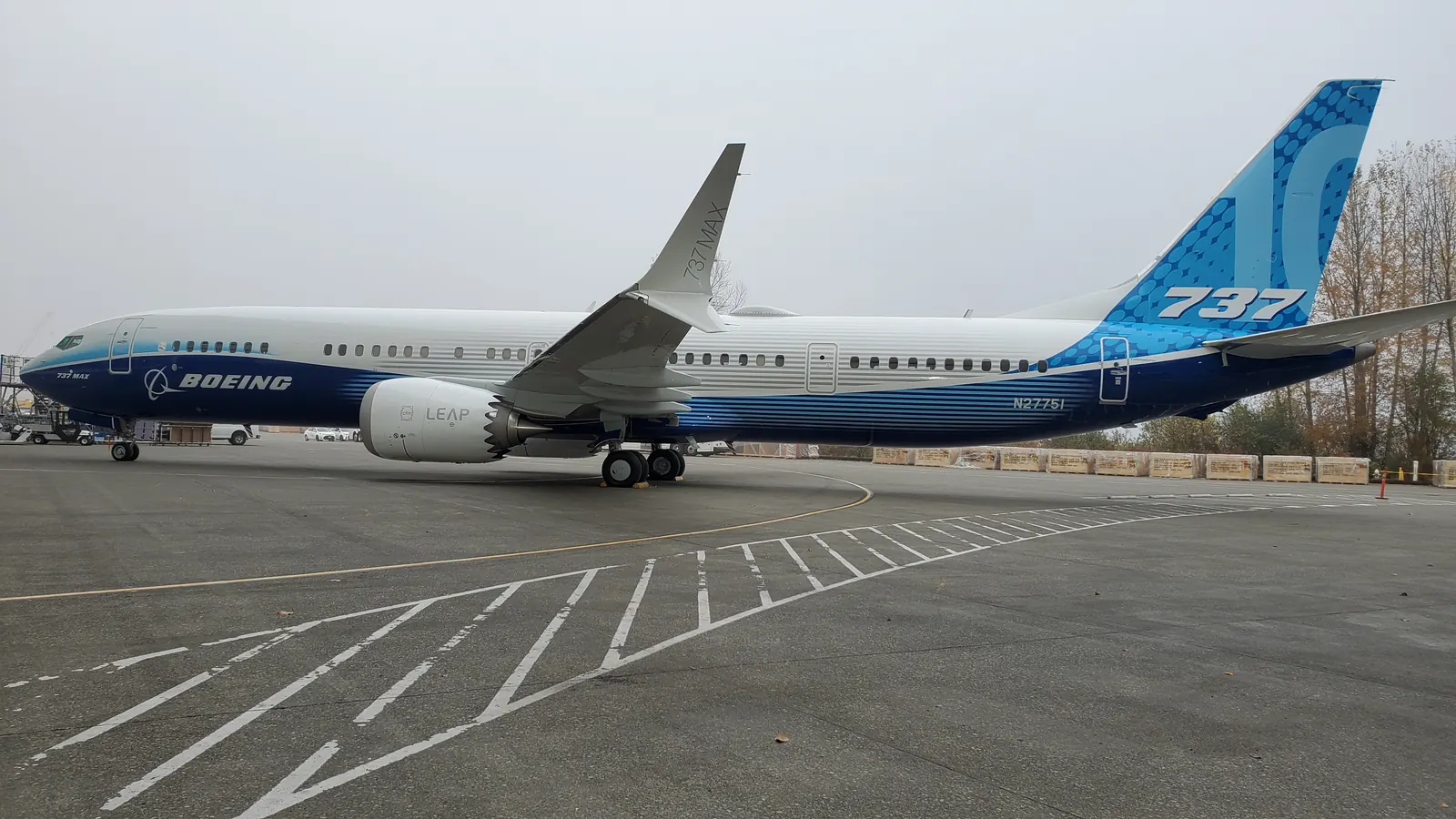
The Federal Aviation Administration issued the amended type certificate for Boeing's 737 Max 10 on Tuesday, along with an updated Production Limitation Record that authorizes the company to build it. The announcement came at Boeing's Everett, Washington factory, the same plant where the first Max 10 fuselage went together in July.
It ends a wait that began at the Paris Air Show in 2017, when Boeing stretched the Max to answer Airbus's A321neo and set the plane to enter service in 2020. It did not. Nine years, two crashes, one door plug and a rewritten certification law later, the largest member of the best-selling family in commercial aviation is finally a product rather than a program.
The stakes are in the order book. Boeing says more than 30 customers have ordered 1,555 Max 10s — better than 30 percent of the unfilled 737 Max backlog — out of 7,350 total Max orders and roughly 2,500 delivered through the end of September. Almost none of that Max 10 revenue has been collected, because airlines pay the bulk of an aircraft's price on delivery. Alaska Airlines alone ordered 105 in January, with options for 35 more, the largest order in its history. Leeham News reports WestJet will be the launch customer, with deliveries starting early next year. Boeing, more optimistically, says "coming months."
What the FAA took in exchange is the more interesting part. The Max 10 is the first commercial airliner certified to the full extent of the Aircraft Certification, Safety and Accountability Act, the 2020 law Congress passed after two Max 8 crashes killed 346 people. That means documented safety assessments and human-factors evaluations, not just flight testing: more than 2,000 flight hours, 1,000 ground test hours, nearly 1,000 test flights and tens of thousands of pages of paperwork. The agency also required an enhanced angle-of-attack system, a redundant sensor architecture lawmakers demanded because a single faulty angle-of-attack reading fed the software that pushed both doomed Max 8s into the ground.
That system is not a Max 10 feature. Boeing says it will become standard across the Max family, with retrofits beginning on aircraft already in service — which, given roughly 2,500 jets already delivered, is the part that matters most to anyone who flies.
There is an asterisk, and it is worth naming. The FAA had been weighing a flight-management software glitch on the aircraft as recently as last month and certified the plane with a known bug, one it judged not safety-critical. That is how certification works: the regulator decides which defects are acceptable, not that none exist. It sits awkwardly against a decade in which the cost of a bad judgement was measured in lives.
Sean Duffy, the transportation secretary, used the ceremony to argue the process should be faster. "It takes Boeing, to certify an aircraft in Europe, about half the time, less than half the time that it does in the U.S.," he told CNBC. "We have to certify aircraft more quickly if we're going to compete as Americans." He also said the review included "thousands of hours of test flights" and called the result "a major win for American manufacturing." Both things can be true, and the tension between them is now the FAA's permanent problem: the same agency spent nine years proving this particular airplane safe, and its political leadership spent the afternoon explaining why the next one should take less time.
As an airplane, the Max 10 is a compromise dressed as an answer. It seats 185 to 210 in two classes, up to 230 in the densest layout, and flies 3,100 nautical miles — less than the smaller Max 9's 3,300, because stretching a fuselage costs range. Its pitch to airlines is not capability but cost: Boeing claims the lowest cost per seat of any single-aisle in service and a 20 percent cut in fuel burn and CO2 against the planes it replaces. The A321neo still carries more passengers over longer ranges. Boeing's argument is that most routes do not need the range, and that at current fuel prices the cheaper seat wins.
Timing matters commercially for a simpler reason. Carriers ordered these jets years ago and have been re-planning around them ever since. United's chief executive said in August that the lie-flat seats it bought for its Max 10s no longer make sense for the cabin and are sitting in a warehouse. Alaska is going the other way, adding lie-flat suites to some of its Max 10s. An airplane delivered late does not arrive into the market that ordered it.
The production side is the open question. Boeing will build most Max 10s on the North Line in Everett, its fourth Max assembly line, opened in July, which is large enough to run Max 10s nose to tail instead of staggering them between smaller variants the way Renton's lines must. The company has been ramping output of both the 737 Max and the 787, which is the machinery its recovery actually depends on.
So the certificate hands Boeing back the permission it lost, and then leaves the harder part untouched. What remains is the thing the company has struggled with for six years: building complex airplanes at rate, correctly, with a supply chain and a workforce that have both been through a lot. Certification was the hard problem everyone could see. Delivery is the one that shows up in the quarterly report.
One milestone does remain. The 777-9 is still in flight test, still without extended-range twin-engine authority, still several quarters from carrying anyone. The Max family is complete. The larger recovery is not.
Sources: Boeing, CNBC, Leeham News
波音最大的737 max已获得认证,现在它必须建造1,555架它们
FAA周二结束了对Boeing建造并交付其最大737 Max的九年等待,订单簿中包含1,555架;工厂将是下一站测试。
联邦航空管理局周二颁发了波音最大型号737 Max的修订型式证书,结束了长达九年的等待。该机构已批准波音可以开始建造并交付其最大的737 Max系列飞机。订单簿中有1,555架;现在工厂是下个考验环节。图片来源:lamblukas (CC BY 2.0)
More Hourlies Stories
Content on Anagnorisis is summarized, paraphrased, and editorialized from publicly available sources for length and clarity. Original sources are linked where available. All trademarks belong to their respective owners.